Important conversations happen too late.
Couples discuss finances, family, and future after disagreement — when emotion overrides clarity.
From assumptions to understanding.
Guided conversations for couples — before commitment, not after conflict.
01 · The Problem
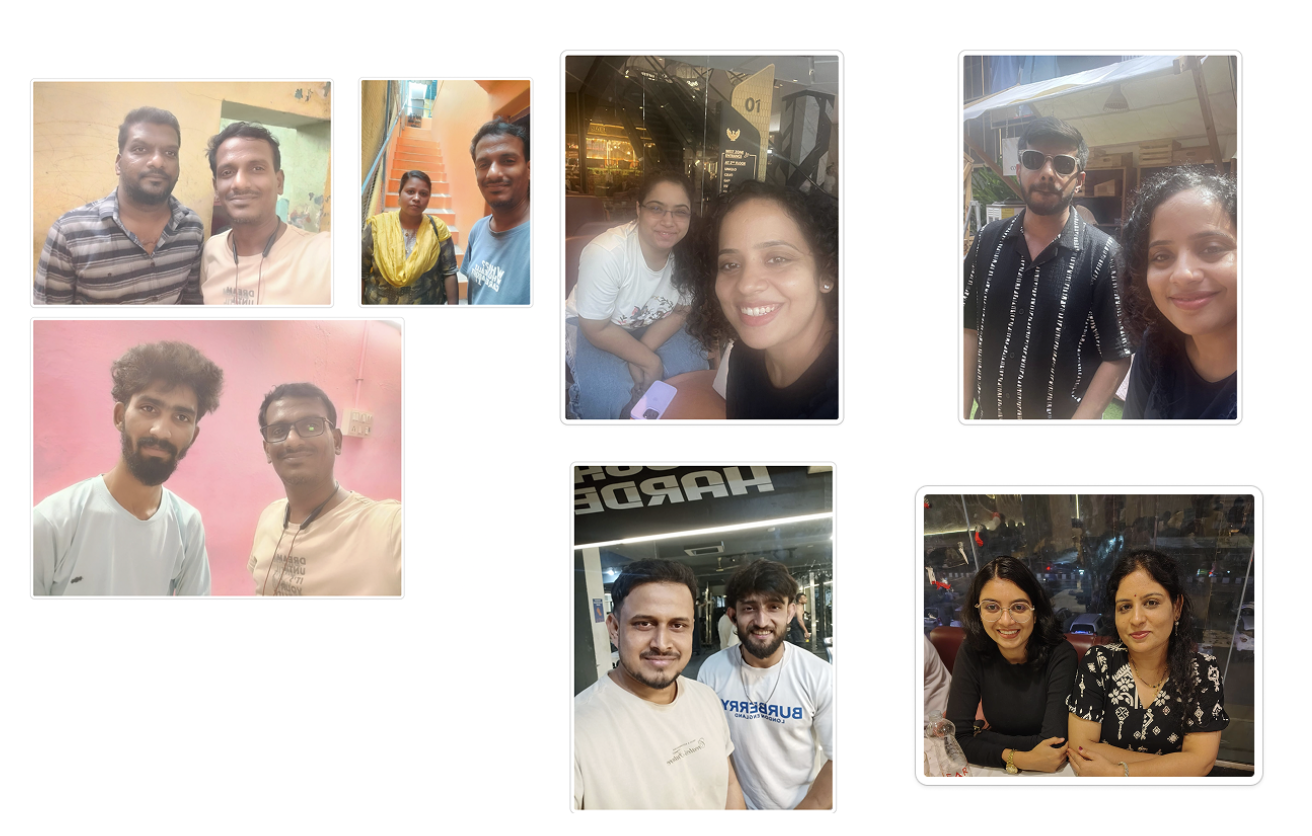
Contextual interviews · 14 participants · Mumbai, Pune, Bengaluru, Chennai
Couples discuss finances, family, and future after disagreement — when emotion overrides clarity.
Shared time gets mistaken for shared expectations. Silence is read as agreement.
Scores and assessments answer a different question than the one couples are actually asking.
“We talk all the time, but we’ve never actually discussed what married life would look like.”
02 · Research
We started without a product hypothesis. We wanted to know what couples avoid, what they wish they could ask, and where current tools fail them.
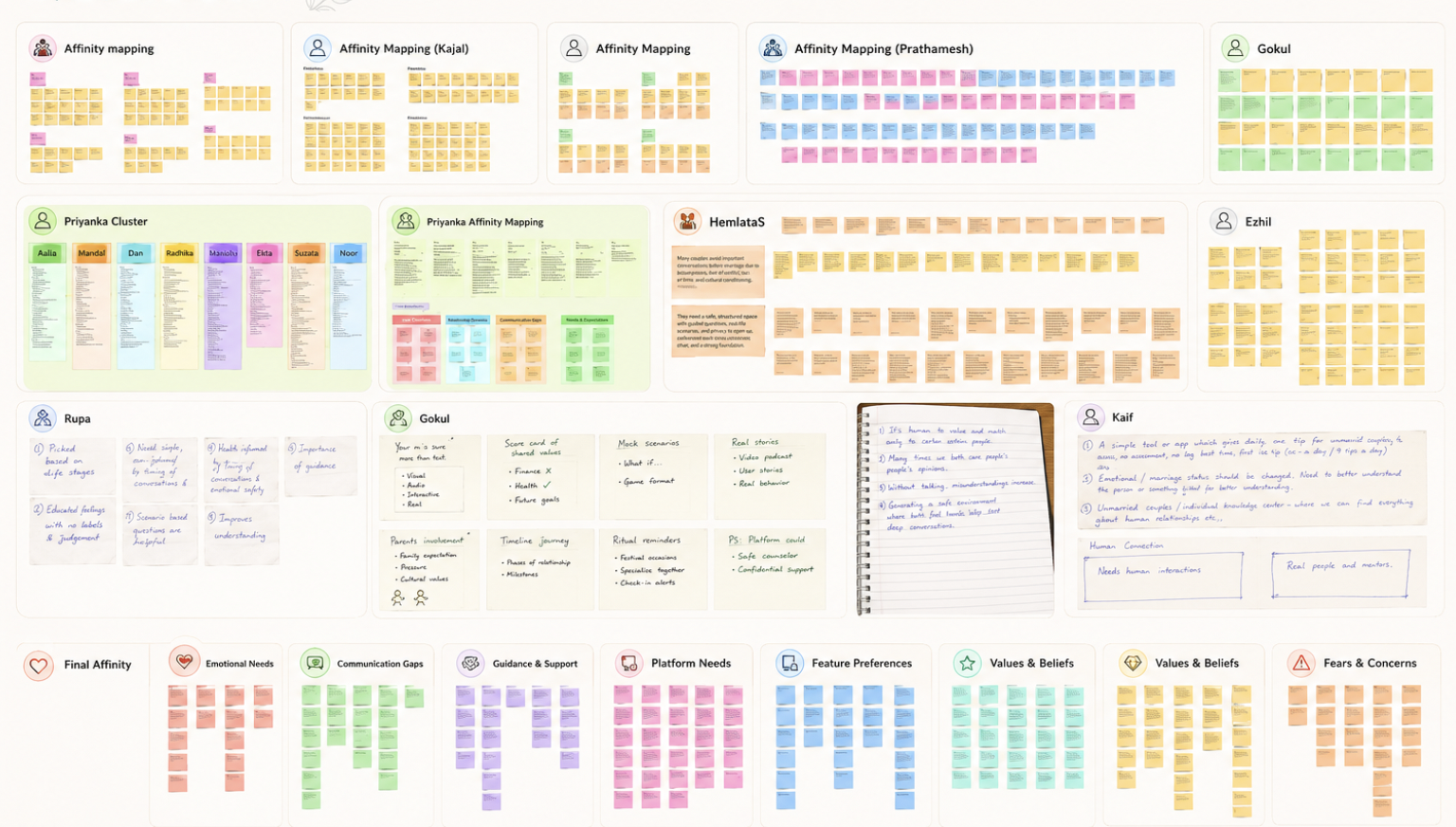
Affinity mapping · Eight parallel boards converged into one shared model
14 contextual interviews · pre-marital, newly-married, long-term couples.
Academic studies on attachment, communication patterns, cultural ritual.
In-home & café conversations to surface unguarded behaviour.
230+ data points clustered into themes by 8 researchers in parallel.
Six recurring tensions distilled from individual mappings.
Field notes · 32 hours of recorded conversation
03 · Key Insight
Couples aren’t avoiding important conversations because they don’t care.
They avoid them because they don’t know how to start safely.
04 · Market Gap
We evaluated key competitors across focus areas, strengths, and gaps.
Before Yes
Strengths
Structured questionnaires and insights.
Gaps
Focuses on assessment rather than conversation.
Paired
Strengths
Daily questions and activities.
Gaps
Designed mainly for existing couples.
Agapé
Strengths
Reflection and communication prompts.
Gaps
Limited support for pre-marital decision-making.
Medical Kundali
Strengths
Health-related transparency.
Gaps
Narrow focus on medical aspects only.
ShaadiSync
Strengths
Planning and coordination.
Gaps
Lacks guided emotional conversations.
Our market scan highlighted a clear gap: most products assess relationships, but few actively help couples have the conversations that shape their future.
Instead of generating compatibility scores, Between Us focuses on guided self-reflection, future-focused scenarios, and safe comparison of responses.
05 · Design Principles
No streaks, no countdowns. The pace belongs to the couple.
Quiet prompts that invite thought, not reaction.
Surface difference without scoring people on it.
One question at a time. One screen, one decision.
06 · Solution Framework
Each partner answers privately, without seeing the other’s response.
Responses are surfaced side-by-side, without scores or judgement.
Guided prompts open the conversation where alignment is unclear.
Insights distil what was learned — not who was right.
07 · Final Product
Each screen is a small moment in the same long conversation — read them in order, like chapters in a relationship journal.
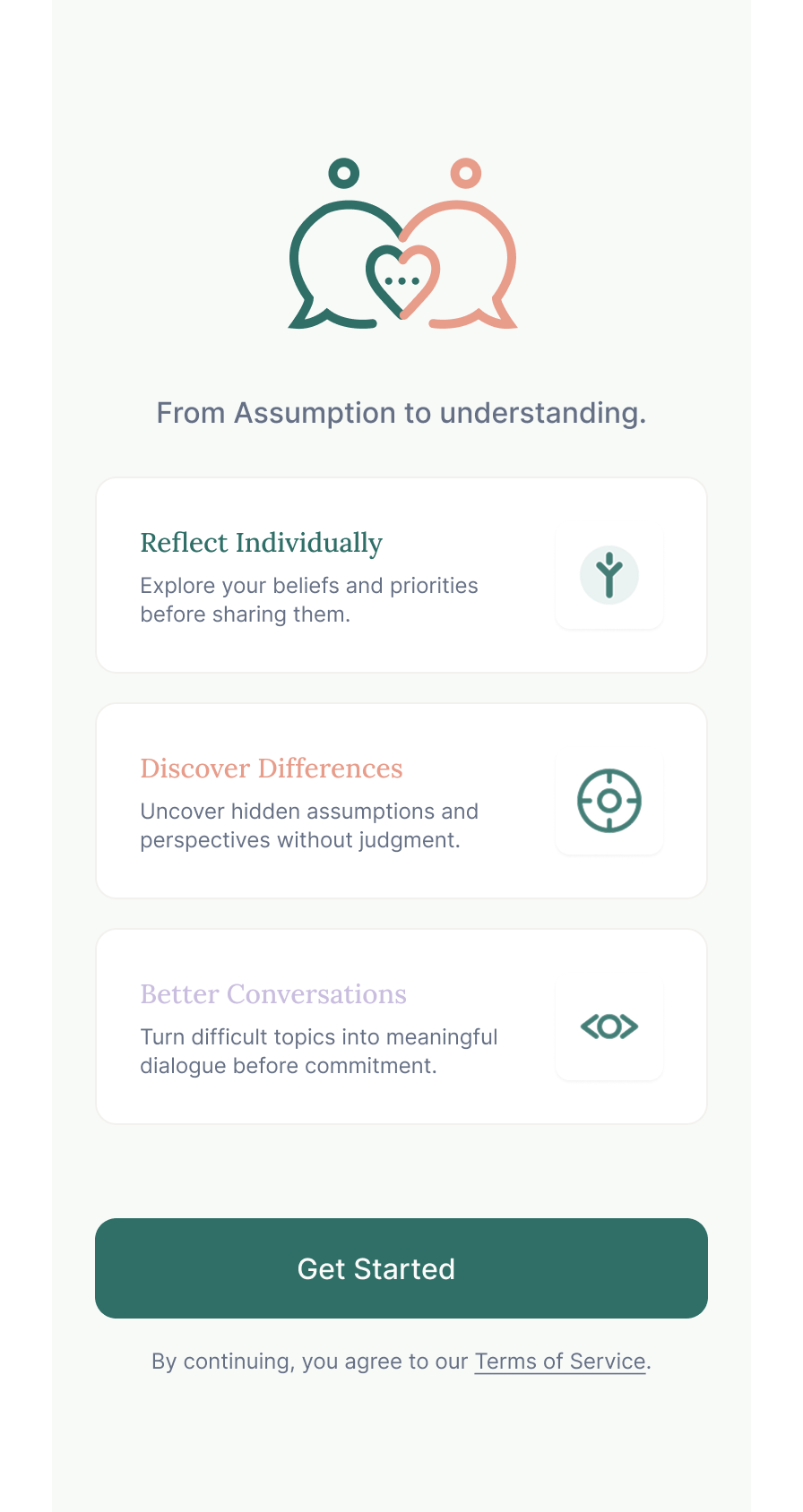
Chapter 01 · Onboarding
Onboarding positions the product as a space for reflection and understanding — not assessment — so couples arrive ready to be honest.
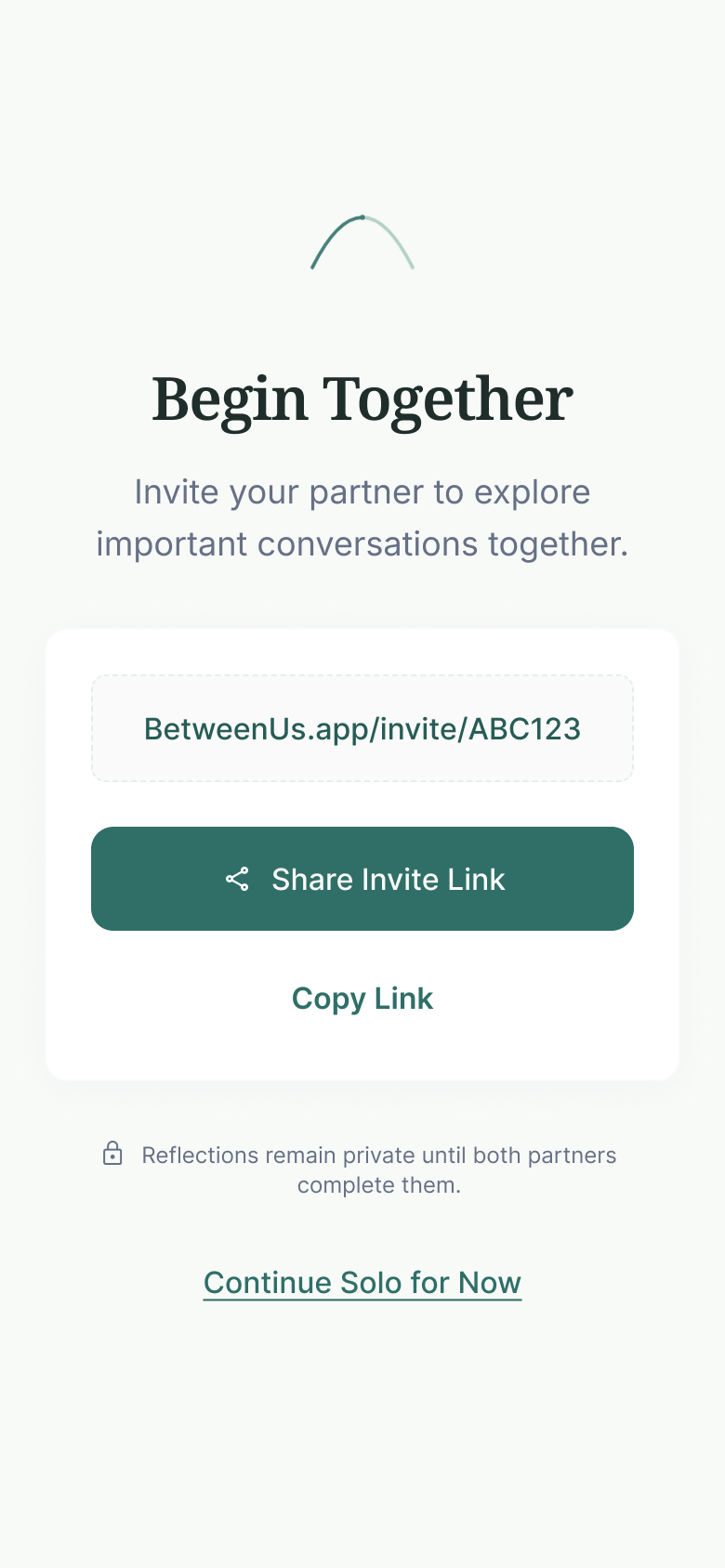
Chapter 02 · Partner Invitation
A simple shareable link brings the second partner in. Reflections stay private until both have completed them, removing pressure to perform.
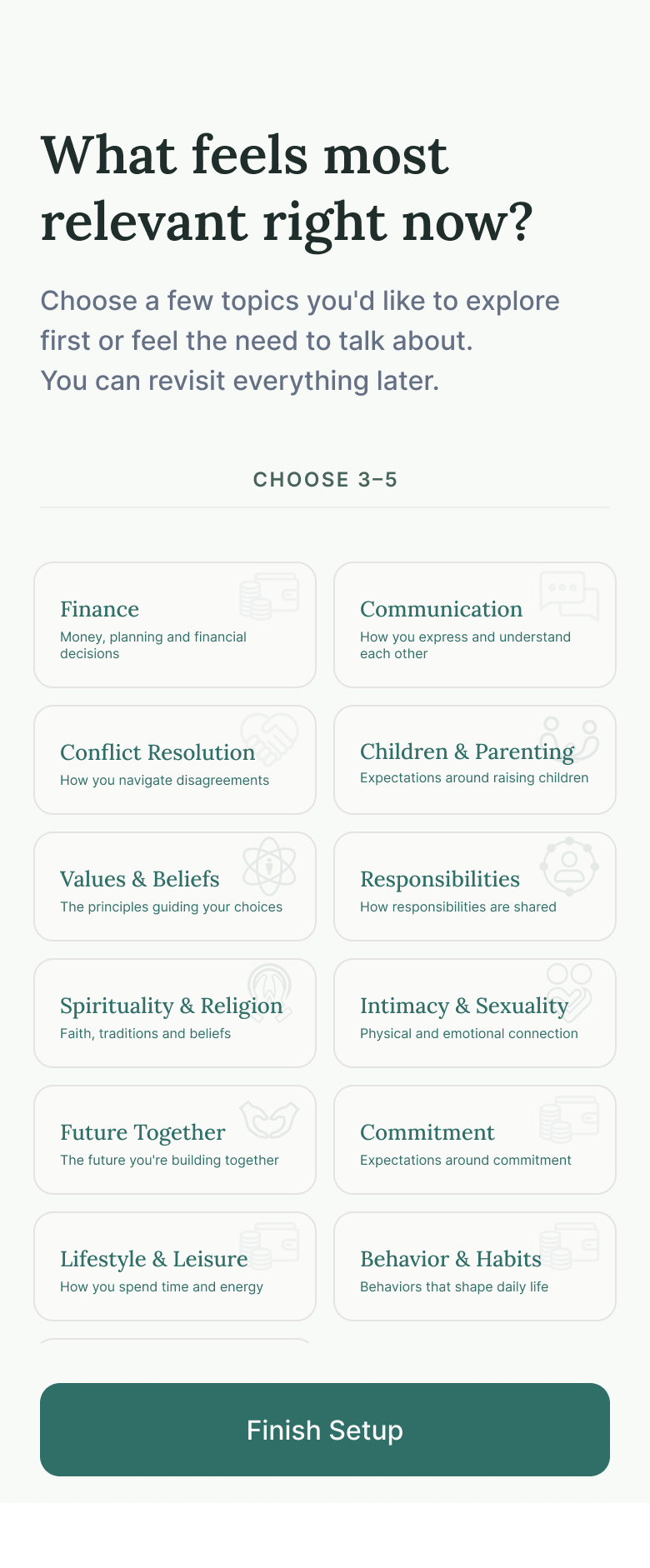
Chapter 03 · Topic Selection
Finances, family expectations, intimacy, future planning — each becomes a focused chapter rather than one overwhelming talk.
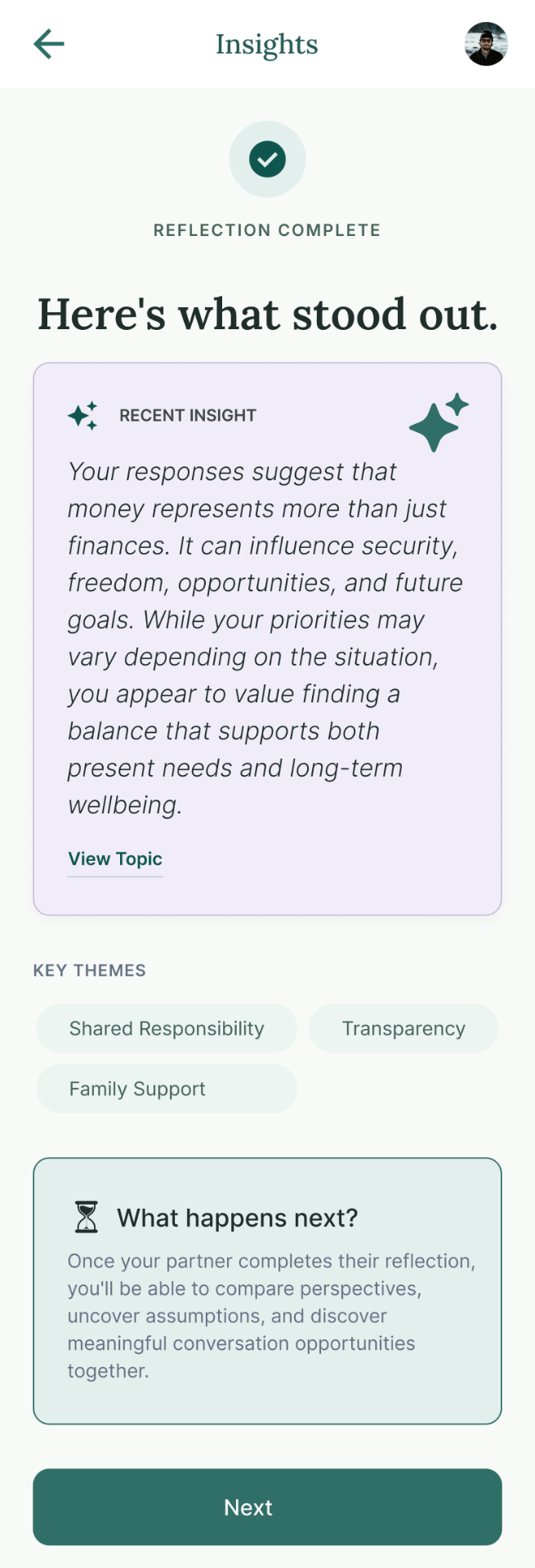
Chapter 04 · Solo Reflection Insight
Personal insight is surfaced first. The product treats reflection as the work, not a step on the way to a score.
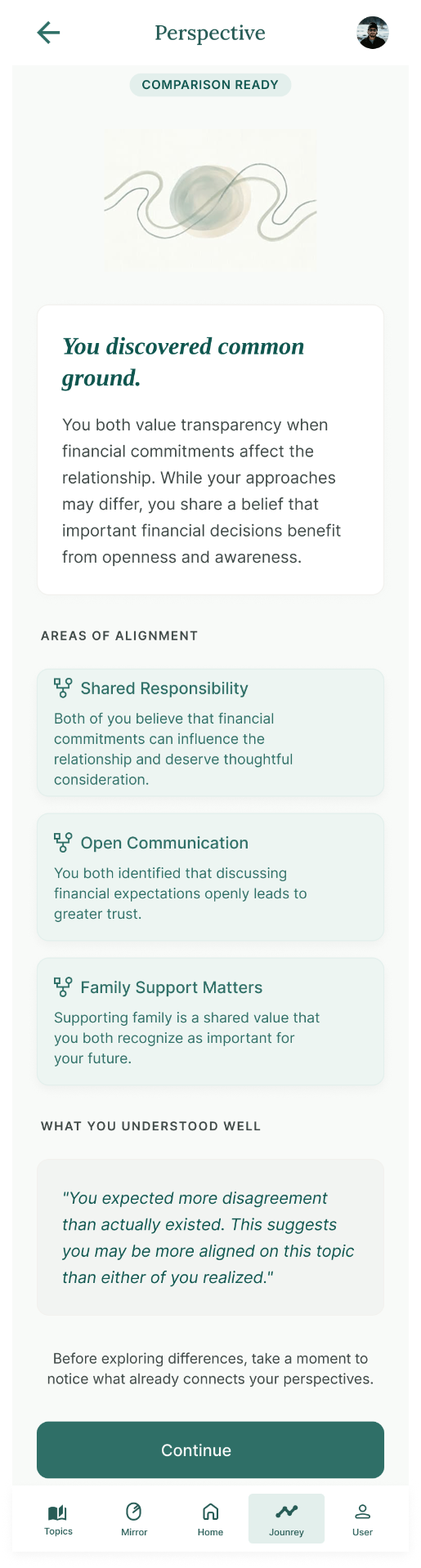
Chapter 05 · Shared Perspective
Differences are framed as opportunities for understanding. Alignment is shown plainly — never gamified into a percentage.
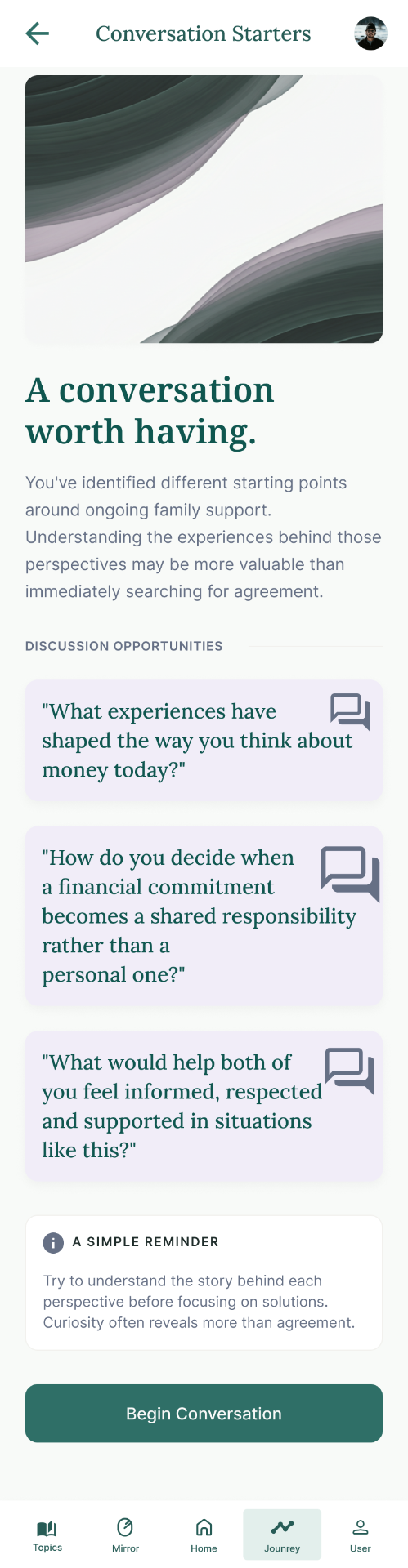
Chapter 06 · Conversation Starters
Open-ended prompts help couples begin the discussions that usually get postponed, with curiosity instead of conclusions.
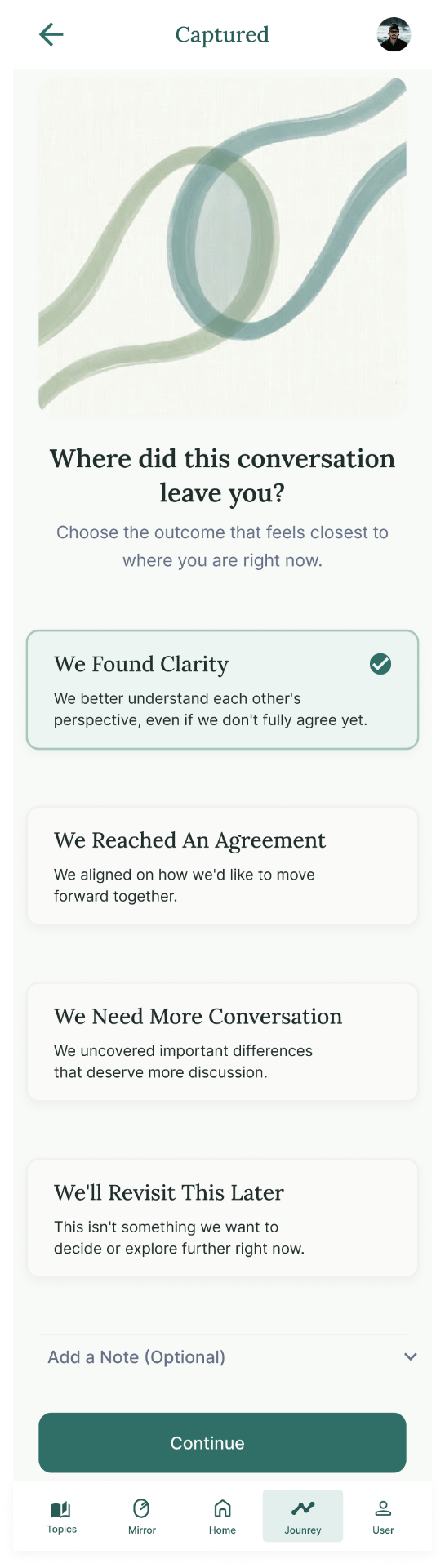
Chapter 07 · Conversation Outcome
Couples close each conversation with a shared outcome — clarity, agreement, more to discuss, or revisit later — building a quiet history together.
08 · Final Prototype
Click through the full flow above.
Hero film at the top of this page.
Section 07 — Final Product.
09 · Design System
Palette
Sage
#2F6F67
Sage Soft
#A8C8BE
Peach
#E89C8A
Lavender
#C9BEDF
Cream
#FAFAF9
Typography
Lora · Serif
Quiet conversations.
Inter · Sans
The body type carries instruction, micro-copy and reflection prompts at a calm pace.
Button
Prompt Card
How do you imagine us, five years in?
Input
10 · Testing & Outcome
Problem
Early testers skipped reflection screens because the framework felt unexplained.
Iteration
Added a short onboarding that framed the loop as private-first, comparison-second.
Impact
Completion of a full reflection round rose from 41% to 78% in moderated sessions.
11 · Outcome
12 · Reflection
Strong relationships aren’t built on perfect compatibility.
They’re built on honest conversations, mutual understanding, and continuous growth.